

It is wholly a confusion of ideas to suppose that the economical use of fuel is equivalent to a diminished consumption. The very contrary is the truth. – William Stanley Jevons
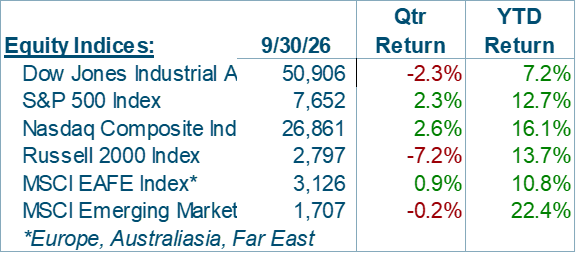 The third quarter was largely uneventful for most investors; economic activity strengthened somewhat, and though corporate earnings were impressive, investors anticipated it. As a result, their response was relatively muted.
Across the U.S. economy, the picture remains the same; a tight but stable labor market supports healthy consumer spending, which is feeding steady growth in both the manufacturing and services sectors. Moderately elevated inflation is the only wrinkle, which is why the Federal Reserve raised its benchmark interest rate in September, and will likely raise it again at least once, if not twice, before year-end.
Outside of the economy and financial markets, the debate around two topics is heating up: Whether the adoption of A.I. will depress or support the labor market, and when the sizable U.S. federal deficit and outstanding debt will begin to factor into investors’ analysis. In this Review we’ll focus on the A.I. debate, leaving the fiscal topic for our year-end Review.
In terms of the A.I. debate, we tend to fall into the optimistic camp. We see tremendous potential for it to facilitate structurally higher labor productivity, a powerful tailwind for small and medium-sized businesses. Our sources suggest that demand for A.I. tools far exceeds what hyperscalers can supply and that this supply imbalance is likely to persist for another year or two at least. It seems that companies are testing A.I. and finding its ROI to be very strong. But they are not furloughing employees as they adopt it. That much is clear.
So at the close of the third quarter, we remain optimistic about the trajectory of economic growth, and though we suspect the fourth quarter will deliver some choppiness for investors, our multi-year outlook remains positive for equity markets overall.
The Global Economy
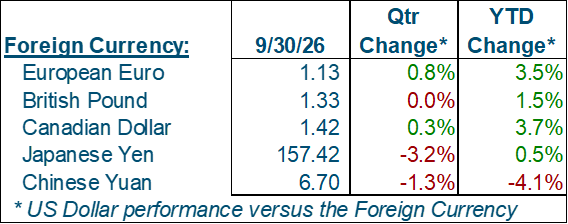 Little changed for the global economy during the third quarter. High energy prices are both a headwind to economic activity and a tailwind for inflation, especially for Europe which depends on external sources for the majority of both its oil (transportation) and natural gas (heating). Economic activity in China is also slowing, but new promises by the U.S. and China to de-escalate trade barriers may provide a lift.
In the U.S. the labor market continues to provide the foundation for ongoing stability. With unemployment in the very low 4% range and monthly payroll additions roughly equal to the number of new labor market entrants, there is neither too much slack nor too much tightness. Average hourly earnings are keeping pace with inflation, and average weekly earnings, which account for the hourly wage in addition to hours worked per week, are growing slightly faster than inflation. Inflation-adjusted, after-tax disposable income also exceeds inflation, and with debt payments (mortgages and consumer credit) as a percentage of disposable income near an all-time low (excluding the Covid era handouts that reached into the trillions of dollars), consumers are comfortable saving less and spending more.
The only wrinkle for the U.S. economy is inflation. The ongoing conflict with Iran and the disruption to traffic passing through the Strait of Hormuz has kept oil prices elevated. But oil prices alone don’t explain moderately elevated inflation. And we’re far beyond any supply shocks from Covid that could be factors. Rather, we suspect the Federal government’s ongoing and sizable fiscal deficits are also starting to play a role in elevated inflation data. Multiple economic theories pin inflation, at least in part if not primarily, to the size of the monetary base (the amount of dollars circulating in the economy), and we’ve noted a steady acceleration in the growth of the money supply this year. That acceleration coincides with a widening U.S. fiscal deficit that will likely reach 6% of GDP this year and may even climb higher next year depending on how the mid-term elections go; most forecasts have Democrats regaining control of the House, which would embolden them to demand even more public spending.
Instead of being the inflation dove many people expected, Federal Reserve Chairman Warsh has turned out to be, at least for the moment, an inflation hawk. He delivered his first rate increase in September, and while he loathes giving forward guidance, his comments in September suggest he may orchestrate at least one, if not two more rate increases before year end.
Equities
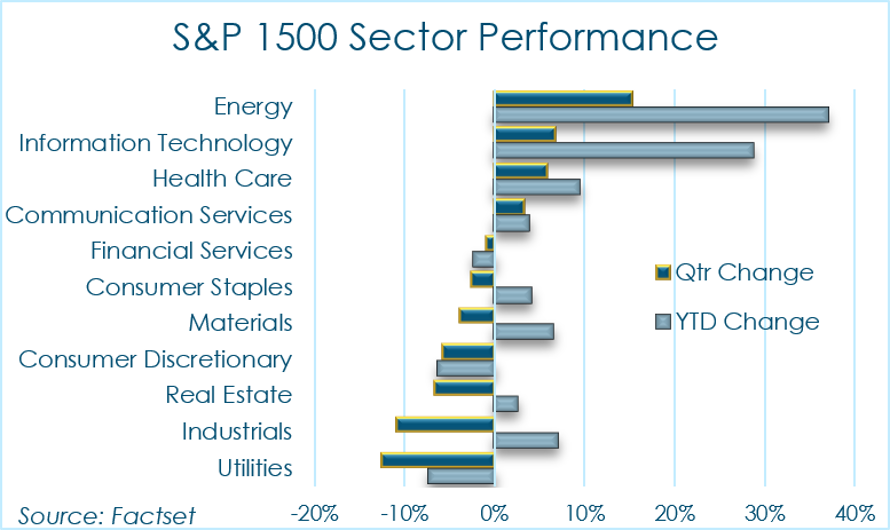 The modest gains for the S&P 500 and Nasdaq Composite were more about the outperformance of large technology companies and are not representative of the broader U.S. equity markets. Using the S&P 1500, which spans large-, mid- and small-capitalization stocks, seven of the market’s 11 sectors declined during the quarter. Small and medium capitalization stocks across all industries declined by mid-single digits. This, despite strong fundamental results and outlooks from companies across all three capitalization tiers. We attribute the disconnect to investor psychology and emotion.
It’s not uncommon for stock prices to temporarily decouple from their underlying fundamental performance, especially when investors have already anticipated strong results and bid up stock prices in advance. Investors are asking “Where does the next positive surprise come from?”. The truth is, with revenues estimated to grow 12% this year (double the pace of overall economic growth), nearly 9% next year, and earnings expected to grow 31% this year and 15% each of the next two years, companies’ ability to deliver even better results is limited. Because of that, investor emotional and psychological momentum appears to have hit a ceiling.
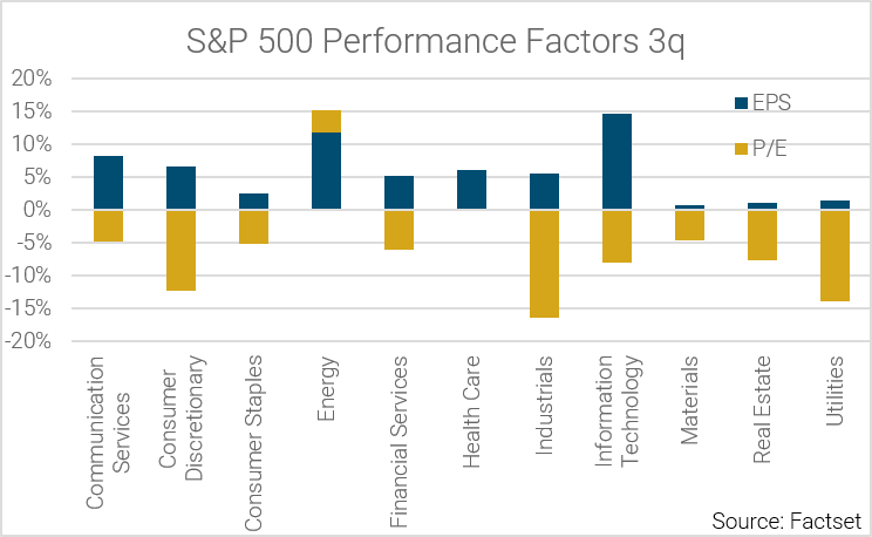 To see this in action, consider the performance split between earnings growth and valuation. Earnings growth was positive for every sector during the quarter, but only one sector, energy, saw its valuation multiple rise during the quarter. Every other sector saw their valuation multiple fall, some by more than 10%. Although investors may be disappointed with declining valuations in the near term, a valuation adjustment such as what occurred during the third quarter removes some frothiness from stock prices and allows fundamental earnings growth to play a more prominent role in stock price performance going forward.
To be clear, we’re not calling a valuation trough; in our view, stock valuations are still elevated. We’re simply noting that stock prices can and do diverge from a company’s underlying fundamental performance because of valuation, but when fundamentals are strong and valuations compress, the risk / reward balance shifts to be more positive in the long-term.
Fixed Income
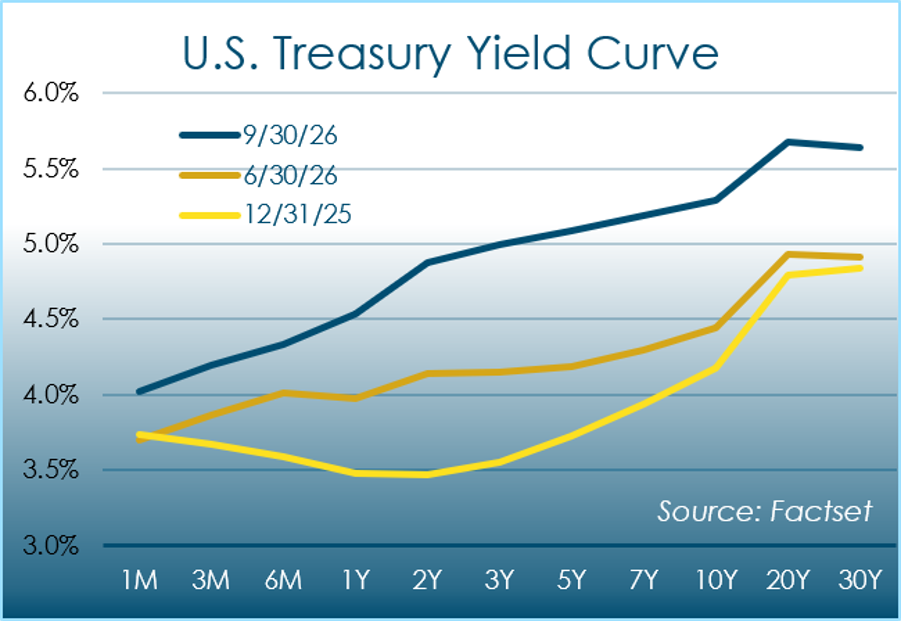 Global bond investors continue to suffer from higher interest rates. Higher inflation is certainly a component of higher rates, but inflation expectations are only modestly higher today than they were at the start of the quarter. Rather, we see myriad factors driving nominal yields higher and bond prices lower: Large corporate bond issuance (to fund A.I. capital investments), growing concern over the medium-term outlook for the U.S. fiscal position and the likelihood the U.S. government will need to issue more Treasuries to fund the deficit, and an expectation that inflation-adjusted economic growth is about to enter a structurally higher phase because of A.I. adoption. If we had to assign weights to each of these factors, we suspect structurally higher economic growth and corporate bond issuance are the two primary factors driving nominal yields higher right now. On the positive side, yield spreads between corporate bonds and U.S. Treasuries remain historically tight, even when looking at the non-investment grade (junk bonds) sector, an indication that investors are not concerned about corporate credit risk, even where corporate credit quality is structurally weaker.
Commodities
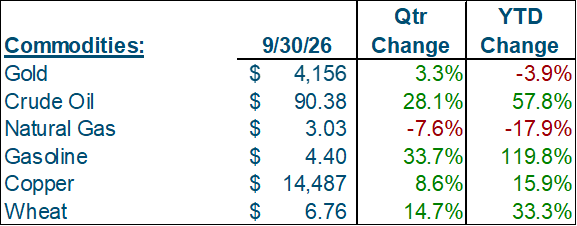 Within the commodity complex, the story continues to be crude oil and gasoline. Coming into the year, global oil production and supply was expected to, once again, exceed demand. With the Strait of Hormuz effectively constrained, Gulf countries are working to re-route oil supply, but their efforts will take time to materialize. In the meantime, the world continues to rely on strategic oil reserves and a natural decline in demand due to higher prices. Oil producers in the Americas are capable of replacing some, but not all, of the supply shortfall, and as a result, Asia and Europe are feeling the effects of higher oil prices. We expect balance in the oil market to gradually return in 2027, which would be disinflationary and positive for global economic activity.
Conclusion
Setting aside the doomsday “Terminator” scenarios that made headlines during the quarter, the more pertinent debate revolves around the impact A.I. will have on the labor market, consumer spending, and overall economic activity. We think Jevons’ Paradox, as it’s known, is the best mental framework with which to assess the impact A.I. will have on economic activity.
William Stanely Jevons was the first to argue that when a technological advance makes a resource more productive, more of that resource is used, not less. Jevons made his observation in the 1860’s after studying the U.K.’s use of coal, which skyrocketed after James Watt introduced a more efficient steam engine (hence, Jevon’s reference to fuel). The standard economic argument at the time claimed that with Watt’s steam engine, less coal was required for the same output, and therefore, coal use would decline. That claim was flawed; it assumed producers would be content maintaining the same level of output with higher profit margins and higher profits. They were not. Profit-maximizing businesses maximize profits at whatever output level maximizes profits.
That means maximizing output until the marginal revenue of the marginal unit of output equals the marginal cost of producing that marginal unit of output. When productivity spikes, marginal profit margins expand significantly, and profit-maximizing businesses expand output to the point where an additional unit of output is no longer profitable. This phenomenon extends to consumers as well and can be seen in rising gasoline use despite more fuel-efficient cars.
We expect the same to happen with business demand for labor as A.I. is increasingly adopted. Today’s A.I. tools, as primitive as they are, improve labor productivity. As A.I. improves and more companies adopt it, the ensuing productivity boom will make labor more valuable as an input, not less. We see A.I. as a labor-enhancing tool, not a labor replacement.
Certainly, specific segments of the labor market will need to make some adjustments, however, small businesses, which employ the majority of employees, have consistently complained that the “quality of labor” prevents them from competing and growing more effectively. A.I. is perfectly suited to improve labor quality because it can be used to train new employees and drive an employee’s capacity to produce more work at higher quality levels.
The ROI on A.I. is perhaps higher than any other technological advancement since James Watt’s steam engine. And because labor productivity drives higher wages, which in turn drive higher household wealth, it should be a win-win-win for companies, employees, and investors. Which is why we have an optimistic outlook on A.I., its impact on the labor market, and economic activity.